Start with the repository
Git, concise Markdown instructions, the agent runtime’s native permissions and focused application CI are the baseline. Add a control when an explicit requirement needs enforcement or structured reporting beyond that baseline.
Check the action
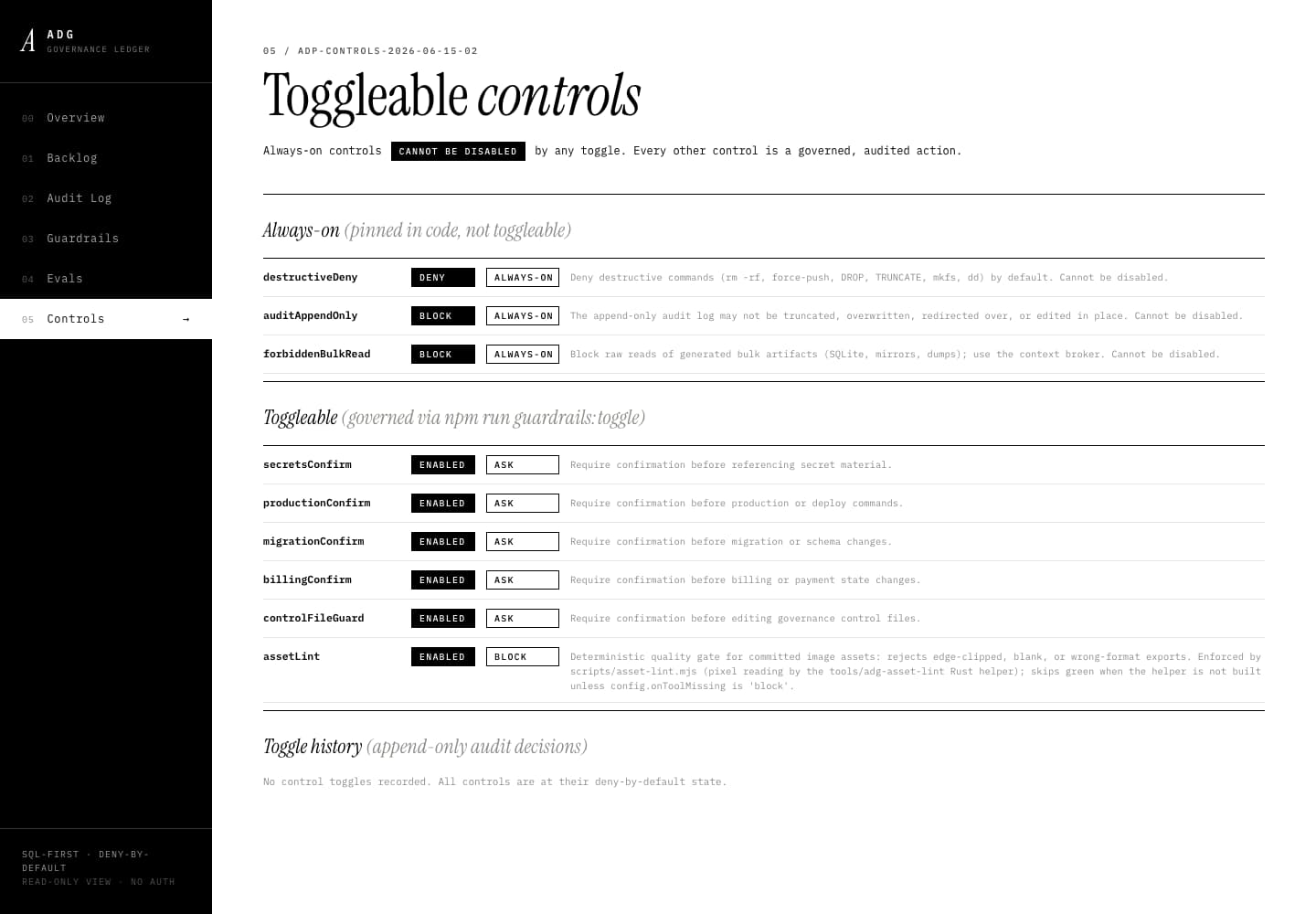
Supported hook adapters and CLI commands apply configured risk and scope checks outside the model. ADG works over the agent runtime; it does not provide an execution sandbox.
- Classify the proposed action and the files it touches.
- Apply the configured action and scope policy.
- Keep native permissions and application checks in place.
Keep reviewable evidence
The advanced governed profile provides evidence tiers, release checks and an append-only audit log with a consistency hash chain. Reviewed Git history remains the trust anchor: a person who can rewrite both the log and its sidecar can forge consistent history.
Adopt structured planning deliberately
The optional SQL profile adds a queryable backlog, requirements lineage, context packets and derived reports. It carries maintenance obligations and is appropriate when the work requires those records. No task-quality comparison against the lightweight baseline has yet been completed.